5-Axis Bridge Saw vs. 3-Axis Bridge Saw: What Can Each Machine Cut?
Nov 03, 2026
When purchasing a CNC bridge saw for a stone fabrication workshop, one important question is often overlooked: What types of stone products can the machine actually cut?
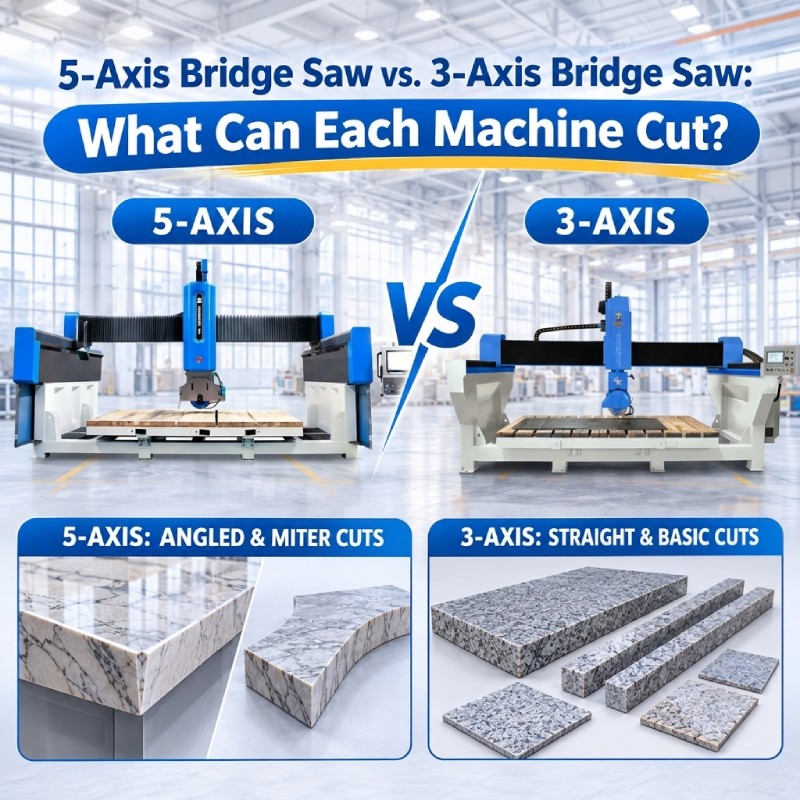
A 3-axis bridge saw and a 5-axis bridge saw may look similar, but their cutting capabilities are different. The main difference lies in how the saw blade moves, rotates, and approaches the stone surface.
A 3-axis bridge saw is generally designed for conventional straight cutting and basic stone processing. A 5-axis bridge saw offers additional rotational movements, allowing it to perform more complex cutting operations, including angled cuts, bevels, and miter joints.
Understanding these differences helps stone fabricators choose equipment according to their actual production requirements rather than simply purchasing a machine with more axes.
1. How Does a 3-Axis Bridge Saw Work?
A 3-axis CNC bridge saw typically operates through three linear movements:
X-axis: Moves the bridge or cutting assembly along the length of the working area.
Y-axis: Controls crosswise movement of the cutting head.
Z-axis: Moves the saw blade vertically to control cutting depth.
The saw blade normally maintains a fixed orientation during automatic cutting. Depending on the machine configuration, the worktable or blade may also support manual or mechanical positioning for certain operations.
What Can a 3-Axis Bridge Saw Cut?
A standard 3-axis bridge saw is suitable for many common stone fabrication tasks:
1. Straight Slab Cutting:Cuts large granite, marble, and quartz slabs into smaller sections for further processing.
2. Rectangular Stone Panels:Produces rectangular and square pieces for flooring, wall cladding, and architectural decoration.
3. Kitchen Countertop Blanks:Cuts stone slabs into basic countertop dimensions before edge polishing, sink opening, and other finishing processes.
4. Stone Strips and Borders:Produces narrow strips for skirting boards, decorative borders, and other standard stone components.
For workshops mainly processing flat stone slabs and standard rectangular products, a 3-axis bridge saw can be a practical and economical solution.
2. How Does a 5-Axis Bridge Saw Work?
A 5-axis CNC bridge saw combines three linear movements with two additional rotational movements. The three linear axes control the position of the cutting head, while the two rotary axes allow the blade to change its cutting direction and inclination.
Depending on the machine design, the additional movements are commonly described as:
A-axis: Rotational movement around one axis.
C-axis: Rotation around another axis, often used to change the blade's cutting direction.
Axis naming and mechanical arrangements can vary between manufacturers. With these additional movements, the saw blade can approach the stone from different angles instead of remaining in one fixed cutting orientation.
What Can a 5-Axis Bridge Saw Cut?
1. 45-Degree Miter Cuts:Creates angled joints for kitchen countertops, waterfall islands, and stone furniture. These joints help two stone pieces fit together with a cleaner corner appearance.
2. Beveled Stone Edges :Produces angled edges for customized countertops, decorative panels, and architectural stone components.
3. Diagonal and Multi-Angle Cuts:Cuts stone along different directions without repeatedly repositioning the workpiece manually.
4. Customized Countertop Shapes:Processes certain irregular countertop outlines and shaped components, depending on the machine's cutting path and software capabilities.
5. Specialized Architectural Stone Components:Supports customized cutting tasks involving angled surfaces, shaped stone parts, and other components that require more flexible blade positioning.
It is important to understand that a 5-axis bridge cutting machine is still a saw-blade cutting machine. It does not automatically replace a CNC stone carving machine or waterjet. Tight curves, intricate internal openings, and detailed three-dimensional carving may require different equipment.
3. 5-Axis vs. 3-Axis Bridge Saw: What Are the Main Differences?
The following comparison explains the differences from a stone fabrication perspective.
Comparison
3-Axis Bridge Saw
5-Axis Bridge Saw
Number of axes
3
5
Movement
Three linear movements
Three linear + two rotary movements
Blade orientation
Generally fixed during automatic cutting
Can rotate and tilt
Straight cutting
Yes
Yes
Rectangular cutting
Yes
Yes
Diagonal cutting
Depends on configuration
Supported
45° miter cutting
Limited or requires additional setup
Supported
Bevel cutting
Generally limited
Supported
Complex cutting paths
More limited
More flexible
Typical applications
Slabs, tiles, countertops
Mitered countertops, angled components, customized stone products
Best suited for
Standard stone processing
Customized and multi-angle stone processing
Note: Actual capabilities depend on the machine's mechanical design, rotary-axis range, blade specifications, worktable configuration, and CNC software. A machine's axis count alone does not guarantee that every cutting operation is available.
4. What Stone Products Can Each Machine Produce?
Choosing a bridge saw becomes easier when comparing the actual products manufactured in a stone workshop.
Products Suitable for Both Machines
Standard granite and marble countertops
Bathroom vanity tops
Rectangular floor tiles
Stone wall panels
Standard-sized stone slabs
Straight-cut decorative stone pieces
Products That Benefit More from 5-Axis Processing
45-degree mitered kitchen countertops
Waterfall kitchen islands
Beveled stone components
Customized angled stone panels
Certain irregular countertop profiles
Specialized architectural stone components
For example, a workshop producing standard rectangular kitchen countertops may find a 3-axis bridge saw sufficient.
However, a manufacturer producing waterfall countertops with mitered corners may benefit from a 5-axis bridge saw because the blade can change its inclination and cutting direction to process the required joints.
Curved profiles should be evaluated separately: the machine must have suitable contour-cutting software and a compatible cutting path. Very tight curves may require a waterjet or another specialized machine.
5. Why Does the Number of Axes Matter in Stone Cutting?
The number of axes affects more than the movement of a machine. It also determines how flexibly the cutting tool can approach a workpiece.
Less Manual Repositioning
A 5-axis bridge saw can complete certain angled cutting operations through programmed blade movements, reducing the need for repeated manual positioning.
More Cutting Possibilities
The additional rotary movements make it possible to process different cutting angles and bevels that are difficult to achieve with a conventional fixed-orientation blade.
Greater Flexibility for Custom Orders
When customers request customized countertops, waterfall edges, or special stone components, a 5-axis machine can provide more processing options.
However, more axes do not automatically mean higher productivity for every job. For large quantities of simple straight cuts, a properly configured 3-axis bridge saw may be the more economical choice.
6. How to Choose Between a 3-Axis and 5-Axis Bridge Saw?
Before purchasing a CNC stone cutting machine, consider the following factors.
1. Your Main Stone Products
If your business mainly processes rectangular slabs, tiles, and standard countertops, a 3-axis bridge saw may meet your requirements. If you frequently produce mitered countertops, angled components, and customized stone products, consider a 5-axis model.
2. Your Cutting Requirements
List the cutting operations you need, including straight cutting, diagonal cutting, 45-degree mitering, beveling, and special-shaped processing. Ask the manufacturer to confirm which operations are supported by the proposed machine configuration.
3. Production Efficiency
Consider whether your current production process involves repeated manual repositioning, multiple setups, or additional cutting equipment. A 5-axis machine may reduce some of these steps when the required operations can be completed in one programmed setup.
4. Investment and Future Development
A 3-axis bridge saw is generally a more straightforward investment for standard cutting work. A 5-axis bridge saw may be more suitable for workshops planning to expand into customized stone fabrication.
The right choice depends on your product mix, production volume, labor costs, and expected return on investment.
7. What Should You Confirm Before Buying a CNC Bridge Saw?
Before placing an order, do not focus only on whether the machine has three or five axes.
Ask the manufacturer to confirm:
Maximum stone processing dimensions and thickness.
Saw blade diameter and spindle power.
Rotary-axis movement range and tilting angle.
Whether 45-degree miter cutting is supported.
Whether the machine supports automatic cutting programs.
CNC control system and compatible design software.
Worktable dimensions and loading requirements.
Installation, operator training, and after-sales technical support.
A practical way to evaluate a machine is to provide the manufacturer with your own stone drawings and ask for a demonstration of the required cutting operations.
8. Jinzuan Machinery: CNC Stone Cutting Solutions for Different Needs
Quanzhou Jinzuan Technology Co., Ltd. (Jinzuan Machinery) specializes in stone processing machinery, including CNC stone carving machines, bridge saws, multi-axis stone cutting machines, profiling cutting machines, and stone polishing equipment.
Different stone fabrication businesses have different production requirements. Some need efficient straight slab cutting, while others require more flexible multi-angle processing.
Jinzuan Machinery provides different machine configurations to support various stone processing applications. When selecting a suitable machine, customers can discuss their stone materials, product dimensions, cutting drawings, and expected production output with our team.
Looking for a suitable CNC bridge saw for your stone workshop? Need help choosing between a 3-axis and 5-axis bridge saw?
Contact Jinzuan Machinery for machine details, configuration recommendations, and a solution based on your stone fabrication requirements.
Read More









 IPv6 network supported