Hidden Costs When Buying CNC Machines
Jun 09, 2026
What Most Buyers Overlook
When purchasing a CNC machine, most buyers focus on one thing first: the machine price.
A supplier offers a CNC machine for $15,000, while another quotes $20,000 for a seemingly similar model. Naturally, many buyers are tempted by the lower price.
However, experienced manufacturers know that the purchase price is only part of the total investment.
The real cost of a CNC machine includes installation, tooling, maintenance, software, training, downtime, spare parts, energy consumption, and many other factors that may not appear on the quotation sheet.
In fact, a machine that costs 20% less initially can sometimes cost 50% more over its service life.
This article explores the hidden costs of buying CNC machines and explains how to evaluate the true long-term value of a machine before making a purchasing decision.
Why Focusing Only on Machine Price Can Be Expensive
Imagine two stone fabrication companies purchasing Cost-Effective CNC stone carving machines.
Machine A
Purchase Price: $18,000
Standard spindle
Basic control system
Limited technical support
Machine B
Purchase Price: $24,000
Industrial-grade spindle
Advanced motion control
Remote diagnostics
Comprehensive training
At first glance, Machine A appears to save $6,000.
However, after three years:
Cost Item
Machine A
Machine B
Initial Purchase
$18,000
$24,000
Spare Parts
$4,500
$1,500
Downtime Losses
$8,000
$2,000
Operator Training
$2,000
Included
Software Upgrades
$2,500
Included
Total Cost
$35,000
$27,500
The cheaper machine ultimately becomes the more expensive investment.
This is why professional buyers evaluate Total Cost of Ownership (TCO) rather than focusing solely on purchase price.
1. Installation and Commissioning Costs
Many CNC buyers underestimate setup expenses.
Depending on machine size and configuration, installation may require:
Foundation preparation
Electrical modifications
Air compressor systems
Water recycling systems
Crane or forklift rental
Technician travel expenses
Example
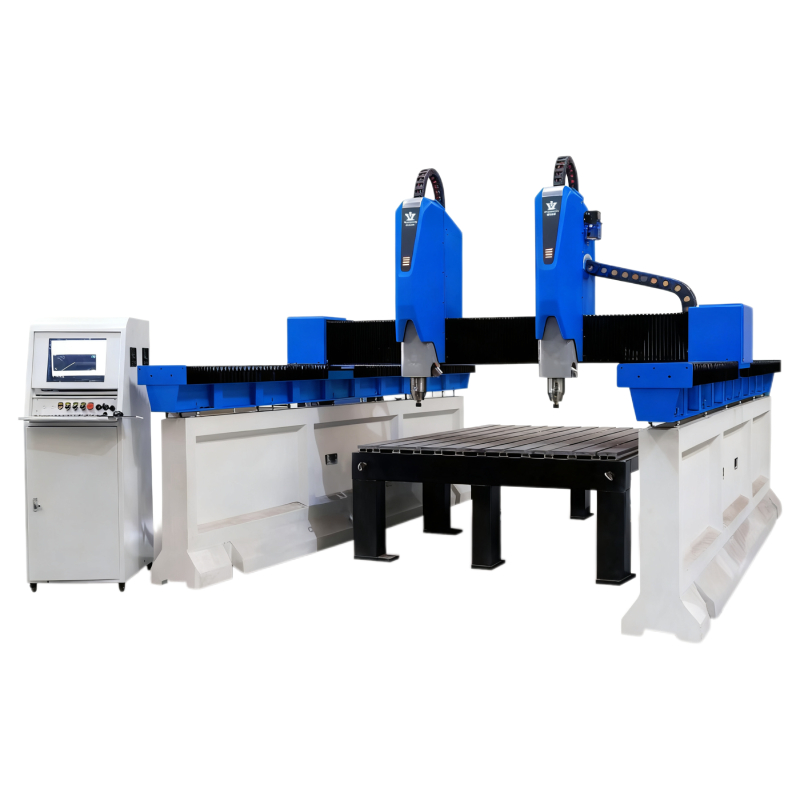
A large bridge saw or 5-axis stone CNC machine may require:
380V industrial power supply
Reinforced concrete foundation
Cooling water circulation system
These additional requirements can add several thousand dollars to the project budget.
Before purchasing, always ask suppliers:
Is installation included?
Are travel expenses included?
What site preparation is required?
2. Tooling Costs Are Often Underestimated
The machine itself cannot produce parts without tools.
For stone processing, tooling may include:
Diamond blades
Milling cutters
Engraving bits
Profiling wheels
Polishing tools
Many first-time buyers budget for the machine but forget that tooling is a recurring expense.
Real Example
A stone workshop producing granite countertops may consume:
3–6 diamond tools per month
Multiple polishing wheels annually
Replacement cutting blades every few months
Over several years, tooling costs can equal a significant percentage of the machine's purchase price.
3. Software Licensing Fees
Modern Industrial CNC machines increasingly rely on specialized software.
Some suppliers provide software permanently.
Others charge annual licensing fees.
Common software expenses include:
CAD software
CAM software
Nesting software
Toolpath generation software
Remote monitoring platforms
Software Model
Cost Structure
Lifetime License
One-time payment
Subscription License
Annual recurring fees
Cloud-Based Platform
Monthly fees
Always verify:
Is software permanently licensed?
Are future upgrades free?
What happens if the subscription expires?
4. Operator Training Costs
Even the best CNC machine cannot perform well without trained operators.
Many manufacturers discover that insufficient training leads to:
Material waste
Tool breakage
Programming mistakes
Production delays
Example
A stone carving machine may achieve ±0.1mm accuracy under normal operation.
However, an inexperienced operator can easily generate toolpath errors that waste expensive marble or granite slabs.
Comprehensive training often provides a much better return than choosing the cheapest machine.
5. Downtime Can Be More Expensive Than Repairs
One hidden cost that buyers rarely calculate is downtime.
When a machine stops working:
Production stops
Deliveries are delayed
Employees remain idle
Customer satisfaction suffers
Practical Scenario
A stone factory producing custom kitchen countertops may lose multiple projects if a CNC machine remains offline for one week waiting for replacement parts.
The actual cost is not the repair itself.
The real cost is lost production.
When evaluating suppliers, ask:
Do they provide remote troubleshooting?
Are spare parts stocked locally?
What is the average response time?
6. Spare Parts Availability
Low-cost CNC machines often use components that are difficult to source internationally.
Common replacement items include:
Servo drives
Motors
Sensors
Spindles
Bearings
Control boards
If replacement parts require weeks of shipping time, production disruptions can become extremely costly.
A reliable supplier should provide:
Spare parts inventory
Technical documentation
Long-term support commitments
7. Energy Consumption Costs
Energy expenses accumulate every day.
Industrial CNC machines may operate:
8 hours per day
16 hours per day
24-hour continuous production
Over time, differences in efficiency become significant.
Example
A stone cutting machine operating 12 hours daily may consume thousands of kilowatt-hours each month.
Machines equipped with:
High-efficiency motors
Intelligent power management
Variable frequency drives
often reduce long-term operating costs considerably.
8. Quality Problems and Material Waste
Machine precision directly impacts profitability.
Poor machine stability can cause:
Incorrect dimensions
Surface defects
Excessive chipping
Rejected products
Stone Processing Example
When processing premium marble slabs worth hundreds or thousands of dollars, a single cutting error can exceed the cost of several machine maintenance visits.
Higher machine accuracy often means lower material waste.
9. Future Upgrade Costs
Production requirements change over time.
A machine that cannot be upgraded may become obsolete much faster.
Important upgrade options include:
Automatic tool changers
Additional axes
Vision systems
Automation modules
Smart factory integration
Machines designed with expansion capability generally provide better long-term value.
How to Identify a CNC Supplier with Lower Long-Term Costs
Instead of asking only:
"What is the machine price?"
Ask:
What is the expected machine lifespan?
How quickly can spare parts be delivered?
What training is included?
Are software updates free?
What maintenance is required annually?
What is the average downtime rate?
Can the machine be upgraded in the future?
What technical support is available after installation?
These questions often reveal more value than the quotation itself.
Conclusion
The price tag on a CNC machine tells only part of the story.
The most successful manufacturers evaluate the complete lifecycle cost of the equipment, including installation, tooling, software, training, maintenance, spare parts, energy consumption, and downtime risks.
A machine that appears more expensive initially may ultimately deliver lower operating costs, higher productivity, and a faster return on investment.
Before signing a purchase agreement, look beyond the quotation and calculate the true cost of ownership. Doing so can save your business thousands of dollars and prevent costly surprises in the years ahead.
Read More










 IPv6 network supported