Is Infrared Laser Guidance Necessary for Accurate Stone Cutting?
May 26, 2026
In modern stone fabrication, precision is no longer just a competitive advantage — it is a basic requirement. Whether processing granite countertops, marble slabs, quartz surfaces, tombstones, or architectural stone panels, customers expect clean edges, exact dimensions, and minimal material waste.
One feature that many buyers notice when choosing a stone cutting machine is infrared laser guidance. Some suppliers promote it as an essential accuracy tool, while others treat it as an optional accessory. This raises an important question:
Is infrared laser guidance truly necessary for accurate stone cutting, or is it simply a convenience feature?
The answer depends on the cutting application, operator experience, production volume, and the level of precision required. In this article, we will explain how infrared laser guidance works, where it delivers real value, and when a stone factory can operate efficiently without it.
What Is Infrared Laser Guidance in Stone Cutting Machines?
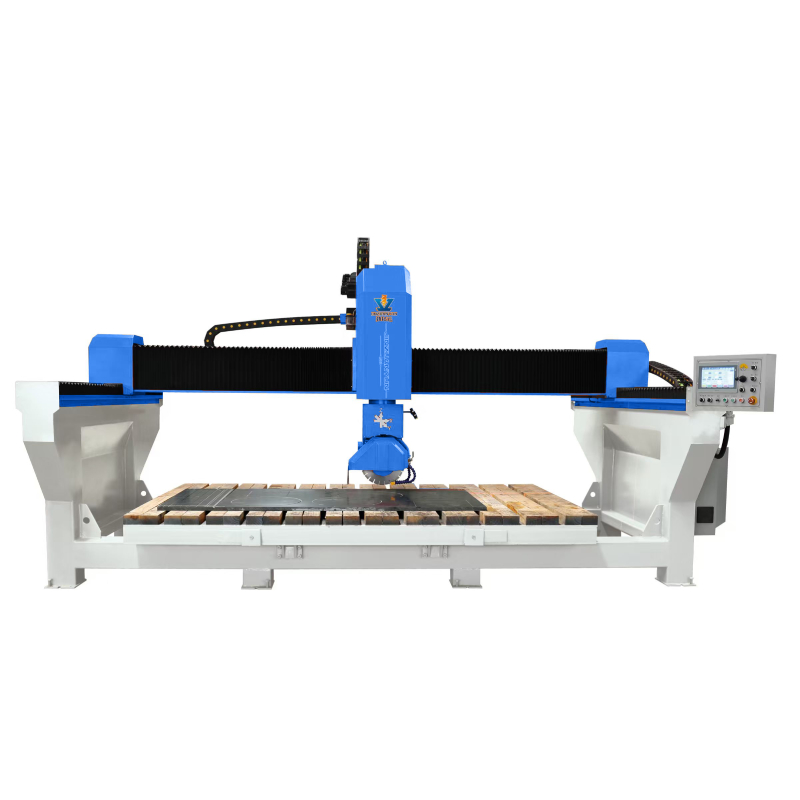
Infrared laser guidance is a positioning system installed on stone bridge saws, edge cutting machines, and manual cutting equipment. It projects a visible laser line directly onto the stone surface, allowing operators to align the blade path before cutting.
The system is commonly used on:
Infrared bridge saw machines
Manual stone cutting machines
CNC bridge saws
Granite slab cutting equipment
Marble tile cutting machines
Stone edge trimming machines
The laser line acts as a visual reference. Before the blade touches the material, the operator can verify:
Cutting direction
Alignment accuracy
Slab positioning
Cutting angle
Material waste area
In many factories, especially those processing expensive natural stone, this simple visual aid significantly reduces human positioning errors.
How Infrared Laser Guidance Improves Cutting Accuracy
Although the laser itself does not physically cut the stone, it helps operators achieve more precise positioning before cutting begins.
1. Reduces Manual Alignment Errors
Without laser guidance, operators often rely on:
Measuring tapes
Chalk lines
Hand marking
Visual estimation
These methods depend heavily on operator experience.
Infrared guidance provides a direct cutting reference line, helping operators align the blade faster and more accurately.
For example:
In a countertop processing workshop cutting quartz slabs worth over $500 per piece, even a 3–5 mm positioning mistake may ruin sink openings or backsplash alignment. Infrared laser positioning helps reduce these risks before cutting starts.
2. Improves Efficiency During Repetitive Cutting
Factories processing large production volumes benefit greatly from faster alignment.
For example:
A stone workshop producing 200–300 marble tiles daily can save several seconds on every alignment operation. Over a full production shift, infrared guidance may reduce setup time by more than 15%.
This is especially valuable for:
Tile production
Tombstone processing
Standard-size slab cutting
Batch fabrication orders
3. Helps New Operators Work More Confidently
Experienced operators can often align cuts manually with high accuracy. However, new workers may struggle with:
Reading blade positions
Understanding offset distances
Maintaining consistent alignment
Infrared guidance shortens the learning curve.
Factories facing labor shortages or high employee turnover often prefer machines equipped with laser guidance because training becomes easier and production consistency improves.
Is Infrared Laser Guidance More Important Than Machine Structure?
No. This is one of the biggest misunderstandings in the stone machinery market.
Many buyers focus heavily on laser positioning while ignoring the machine’s actual mechanical quality.
In reality, cutting accuracy depends primarily on:
Factor
Influence on Accuracy
Machine frame stability
Extremely high
Linear guide quality
Extremely high
Spindle vibration control
Extremely high
Blade quality
High
Servo motor precision
High
Cooling system stability
Medium
Infrared laser guidance
Supportive only
A poorly built machine with laser guidance will still produce inaccurate cuts.
Meanwhile, a High-rigidity Bridge Saw with stable rails and quality servo systems can achieve excellent precision even without infrared assistance.
For example:
A heavy-duty granite bridge saw with a reinforced cast-iron structure operating continuously for 72 hours in a high-temperature workshop may maintain cutting deviation within ±0.5 mm because of structural rigidity — not because of the laser itself.
Infrared Laser Guidance vs CNC Automatic Positioning
Modern stone factories increasingly compare traditional infrared bridge saws with CNC bridge saw machines.
Here is the practical difference:
Infrared Laser Guidance
CNC Automatic Positioning
Manual alignment assistance
Fully automatic positioning
Lower cost
Higher investment
Suitable for small workshops
Suitable for mass production
Depends on operator skill
Reduced human intervention
Faster installation
Higher automation complexity
Good for simple straight cuts
Excellent for complex cutting patterns
For small and medium-sized fabrication shops, infrared bridge saws remain highly popular because they offer a good balance between affordability and operational efficiency.
However, for factories producing customized countertops, sink cutouts, and irregular stone shapes, CNC bridge saws provide superior repeatability and automation.
Common Situations Where Infrared Guidance Is Especially Useful
1. Marble Slab Cutting
Marble often contains natural veins and color variations. Operators use infrared lines to optimize cutting direction and preserve visual aesthetics.
2. Tombstone Manufacturing
Symmetrical engraving borders and edge cuts require accurate positioning to maintain consistency across batches.
3. Quartz Countertop Processing
Laser guidance helps align sink holes, faucet openings, and edge trimming before final cutting.
4. Thin Tile Production
Thin ceramic and stone tiles are more sensitive to alignment deviations. Infrared positioning reduces edge waste and cracking risks.
Situations Where Infrared Guidance May Be Less Important
Infrared systems are useful, but not every workshop absolutely needs them.
1. Fully Automated CNC Production Lines: Modern CNC systems already calculate and control cutting paths digitally.
In these cases, the operator relies more on software calibration than visual laser alignment.
2. Experienced Master Operators: Some highly experienced operators can manually align slabs very accurately using traditional measurement methods.
3. Low-Precision Rough Cutting: For rough block cutting or preliminary slab sizing, laser guidance may provide limited additional value.
Does Infrared Guidance Affect Cutting Speed?
Indirectly, yes.
The laser itself does not increase blade rotation speed or feed speed. However, it reduces:
Repositioning time
Measuring time
Alignment corrections
Operator hesitation
This improves overall workflow efficiency.
For example:
A factory processing 50 granite countertops daily may save 1–2 labor hours per shift simply by reducing repeated measurements and alignment adjustments.
Over a year, this operational efficiency improvement becomes financially meaningful.
Frequently Asked Questions (FAQ)
Q1: Can infrared laser guidance improve actual blade precision?
No. The laser helps with positioning accuracy before cutting. Actual cutting precision still depends on machine rigidity, blade quality, rail systems, and spindle stability.
Q2: Is infrared guidance necessary for granite cutting?
It is highly recommended, especially for expensive granite slabs where positioning mistakes can cause costly waste.
Q3: Does laser guidance require frequent maintenance?
Usually not. Most systems only require occasional calibration and lens cleaning.
Q4: Can infrared systems work in dusty stone workshops?
Yes, but industrial-grade sealed laser systems perform better in environments with heavy dust and water spray.
Q5: Is infrared guidance suitable for beginners?
Absolutely. It helps reduce operator training difficulty and improves confidence during machine operation.
How to Choose a Stone Cutting Machine Beyond Laser Features
When evaluating a stone cutting machine, professional buyers should focus on the complete system instead of only the laser feature.
Important evaluation factors include:
Machine body structure thickness
Rail and guide brand quality
Servo motor stability
Cutting blade compatibility
Water cooling efficiency
Electrical system reliability
Software integration
After-sales technical support
Spare parts availability
Laser calibration stability
A reliable supplier should provide:
Real factory operation videos
Long-hour continuous cutting demonstrations
Accuracy testing reports
Customer project references
Export experience for your market
These factors build long-term production reliability far more than a single accessory feature.
Final Verdict: Is Infrared Laser Guidance Necessary?
Infrared laser guidance is not the core source of cutting precision — but it is an extremely practical tool that improves positioning efficiency, reduces operator errors, and enhances workflow consistency.
For most stone fabrication workshops, especially those processing valuable slabs or handling medium-to-high production volumes, infrared guidance offers clear operational benefits at relatively low cost.
However, buyers should understand that true cutting accuracy ultimately depends on the machine’s structural quality, motion control system, and overall engineering design.
The best approach is to view infrared laser guidance as a productivity-enhancing assistant rather than a replacement for high-quality machine manufacturing.
Read More










 IPv6 network supported