What Information Should You Send a Supplier for the Right Stone CNC Machine Recommendation?
Nov 12, 2026
Choosing a suitable stone CNC machine is an important step for any stone processing business. However, many buyers are unsure what information they should provide when first contacting a manufacturer or supplier.
Do you need a complete technical drawing? Must you know the machine model in advance? What if you only have a product photo or an initial idea?
The good news is that you don't need to understand every machine specification before making an inquiry. Providing a few key details about your products and production requirements is usually enough for a supplier to start evaluating suitable solutions.
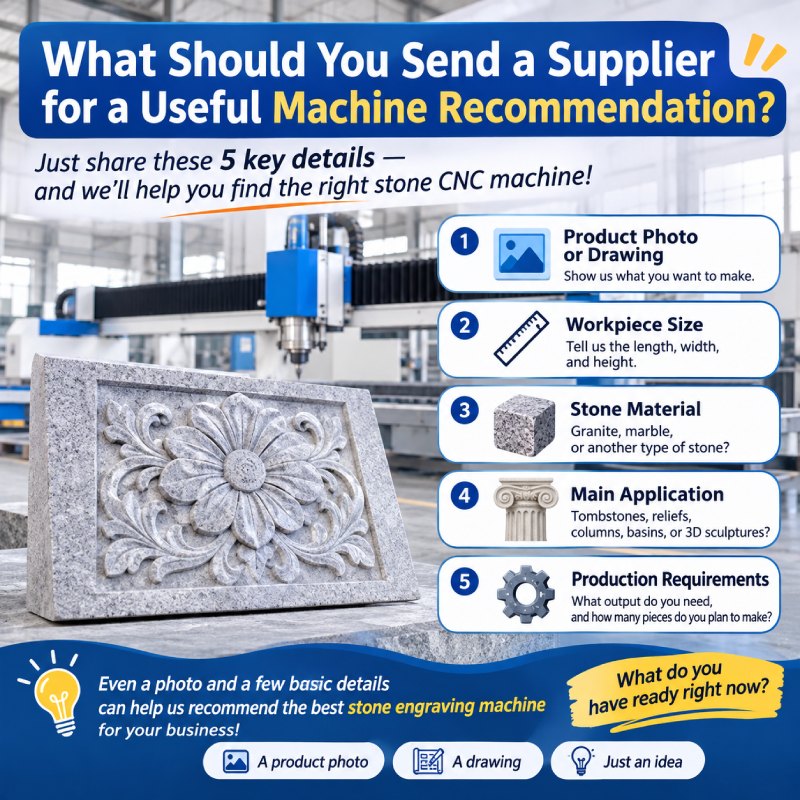
This guide explains the five essential types of information to prepare before requesting a stone CNC machine recommendation, helping you communicate more efficiently and avoid choosing equipment that does not match your actual production needs.
1. Product Photos, Drawings, or Design Files
The first thing to share is what you actually want to manufacture. A clear product photo can help a supplier understand the product's shape, structure, surface details, and machining complexity. If available, a technical drawing or CAD file provides more accurate information about dimensions, curves, angles, and machining details.
For example:
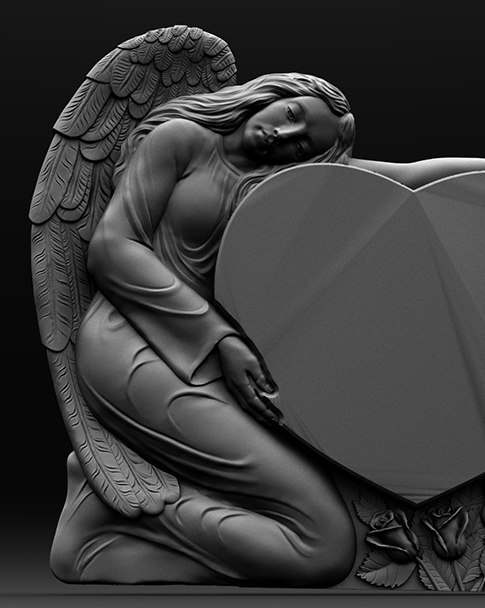
Tombstones: Share the overall shape, lettering, decorative patterns, and engraving depth.
Stone columns: Provide the column profile, diameter, height, and decorative details.
Stone reliefs: Show the pattern complexity, carving depth, and overall dimensions.
Stone sculptures: Share multiple views or 3D design files to illustrate the required shape.
Why does this matter?
Different products require different machining methods. Flat engraving, cylindrical carving, profile cutting, and complex 3D carving may require different machine configurations and axis movements. A photo is a good starting point, while a detailed drawing helps the supplier recommend a more precise solution.
2. Workpiece Dimensions
The dimensions of your stone products directly affect the machine's working area and feeding height.
At a minimum, provide:
Length: Maximum workpiece length.
Width: Maximum workpiece width.
Height or Thickness: Maximum stone thickness or product height.
For example, if you mainly process stone slabs measuring 1500 × 3000 mm, a machine with a suitable working platform must be selected. If you manufacture thick stone monuments or large columns, the Z-axis feeding height and machine clearance also need careful consideration.
Here are some examples of CNC stone carving machine configurations:
Machine Model
Working Area
Typical Application
1515T-1D
1500 × 1500 mm
Small and medium-sized stone engraving
3015T-1D
3000 × 1500 mm
Tombstones, stone reliefs, decorative panels
2515T-1D
2500 × 1500 mm
Medium-sized stone carving and engraving
3015T-2D
3000 × 1500 mm
Higher-output processing with two carving heads
Note: These are representative machine configurations. Actual processing capacity depends on the machine's Z-axis clearance, workpiece geometry, tooling, and customized specifications.
If you frequently process oversized or unusually thick stone products, mention this at the beginning of your inquiry. The supplier can then evaluate whether a standard machine or a customized configuration is more appropriate.
3. Stone Material
Not all stone materials behave the same way during CNC machining. Granite, marble, limestone, and other natural stones differ in hardness, density, grain structure, and machining characteristics.
For example:
Granite: Relatively hard and abrasive, requiring suitable cutting tools, spindle power, and machining parameters.
Marble: Generally easier to carve than granite, making it suitable for decorative reliefs, lettering, and detailed patterns.
Limestone: Often used for architectural decoration, sculptures, and ornamental carving.
The material helps determine the recommended spindle power, cutting tools, processing speed, and machining strategy. If you work with several types of stone, list your main materials and indicate which one accounts for the largest proportion of production. This allows the supplier to recommend a machine based on your actual processing conditions rather than making assumptions.
4. Main Application and Machining Requirements
Knowing the general purpose of the machine is not enough. It is also important to explain the specific operations you expect it to perform.
Different applications may require different machine structures and axis configurations.
Main Application
Recommended Machine Type
Key Consideration
Tombstone engraving
3-axis CNC stone carving machine
Lettering, patterns, and engraving depth
Stone relief carving
3-axis CNC carving machine
Working area and spindle performance
Cylindrical column carving
CNC machine with rotary axis
Diameter, length, and rotary machining
Complex 3D sculpture
4-axis or 5-axis CNC machine
Multi-angle machining and product geometry
Stone slab cutting
CNC bridge saw or stone cutting machine
Cutting dimensions and blade movement
Profiled stone processing
Profile cutting machine
Required edge shape and profile accuracy
For instance, a customer producing flat tombstones may only need a conventional 3-axis stone carving machine. However, a workshop manufacturing decorative columns may benefit from a machine equipped with a rotary axis.
For complex stone components involving multiple surfaces and angles, a multi-axis machine may be a better option. The key is to select the machine according to the machining operations you actually need, rather than simply choosing the machine with the most axes.
5. Production Capacity and Future Plans
Your production requirements help determine how many machining heads, how much automation, and what level of processing efficiency you need.
Consider the following questions:
How many pieces do you expect to process per day or month?
Is your production mainly customized or batch-based?
Do you need to process several identical products simultaneously?
Will your production volume increase in the next few years?
Do you need manual loading or an automated production solution?
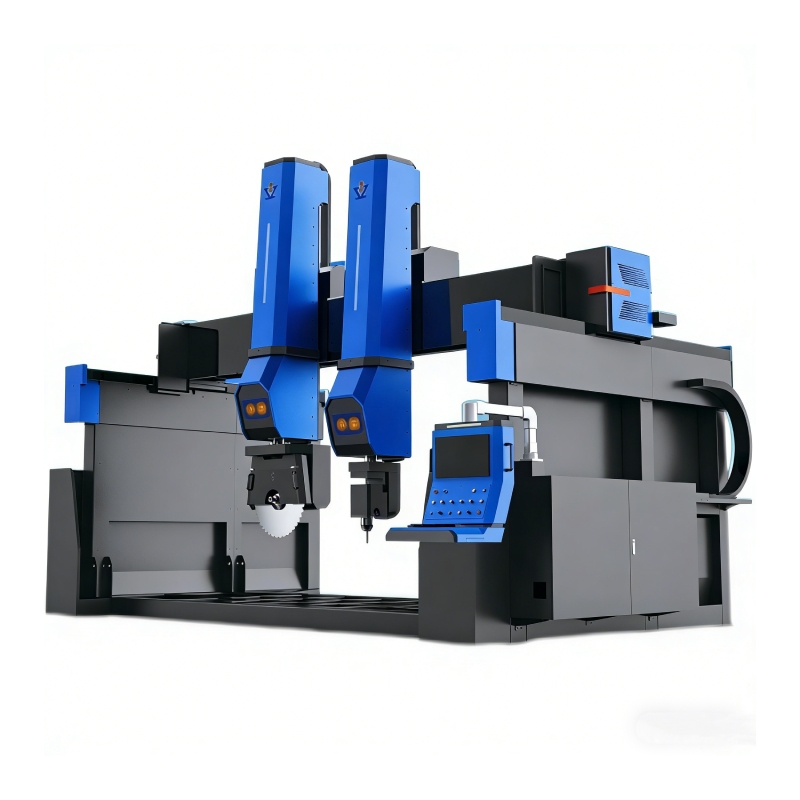
For example, a small workshop producing customized stone monuments may find a single-head CNC machine sufficient. A factory processing multiple identical stone products in batches may benefit from a double-head or triple-head machine, depending on product size, machining paths, and actual production requirements.
At Jinzuan Technology, different configurations are available for different production needs, including single-head, double-head, and multi-head stone carving machines, as well as rotary-axis and multi-axis CNC solutions. The right configuration should balance production capacity, investment cost, product variety, and available workshop space.
What If You Don't Have All Five Items Ready?
That's perfectly fine. You can still contact a supplier with the information you currently have.
Information Available
What the Supplier Can Help Evaluate
Product photo
Basic machining method and possible machine type
Technical drawing
Working area, feeding height, and machining configuration
Stone material
Suitable spindle power and tooling considerations
Production quantity
Number of heads and production configuration
Only an initial idea
Possible processing methods and equipment options
The more detailed your information is, the more accurate the recommendation can be. However, you do not need to prepare everything before starting a conversation. An experienced stone machinery manufacturer can help you clarify the missing technical details step by step.
How Does Jinzuan Technology Help You Choose the Right Machine?
At Quanzhou Jinzuan Technology Co., Ltd., we focus on stone processing machinery, including CNC stone carving machines, multi-axis carving solutions, bridge saws, profile cutting machines, and stone polishing equipment.
Our machine configurations cover different working areas, spindle options, machining requirements, and production capacities. We understand that every stone factory has different products, materials, workshop conditions, and investment plans. Therefore, our recommendation process starts with understanding your actual production needs rather than simply suggesting a standard machine model.
Based on your product photos, drawings, workpiece dimensions, stone materials, and production targets, our team can help evaluate:
Suitable machine types and axis configurations.
Required working area and Z-axis feeding height.
Spindle power and machining requirements.
Single-head or multi-head configurations.
Standard or customized machine solutions.
Our goal is to help you find a practical stone CNC machining solution that matches your products and production plans.
Ready to Find a Suitable Stone CNC Machine?
You don't need a complete technical specification to get started. Just send us what you have, and we can help you work out the next steps.
Send Jinzuan Technology the following information:
Product photo or drawing.
Workpiece dimensions.
Stone material.
Main machining application.
Expected production quantity.
Whether you are setting up a new stone workshop, upgrading existing equipment, or looking for a more efficient CNC carving solution, our team is ready to discuss your requirements. Contact Jinzuan Technology today and let us help you find the right stone processing machine for your business.
Read More











 IPv6 network supported