One CNC Machine, Dozens of Villa Stonework Possibilities
Sep 16, 2026
When people first see a large villa covered with carved stone, a common question is:
“Can one CNC stone carving machine really make all of this?”
The answer is yes—but with an important explanation.
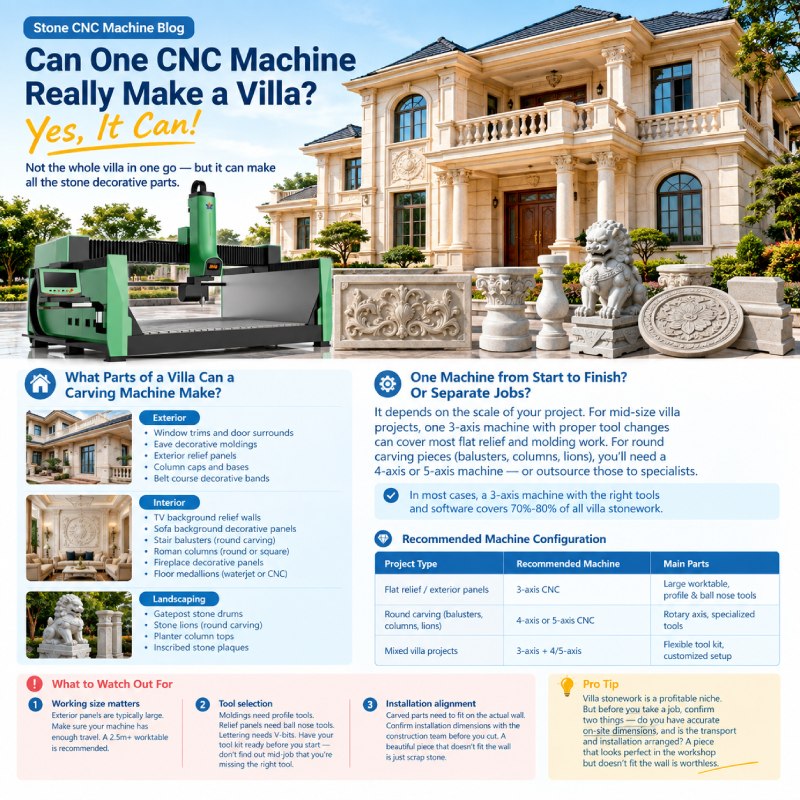
A stone CNC carving machine does not build the villa itself. Instead, it can manufacture a large portion of the decorative stone components used throughout the villa, from exterior window surrounds and column caps to interior relief panels, balusters, fireplace decorations, and landscaping elements.
For stone fabricators, contractors, and villa decoration companies, this makes a CNC stone carving machine a powerful production tool for customized architectural stonework.
What Can a CNC Stone Carving Machine Make for a Villa?
Villa stonework is not just one type of product. It usually includes flat panels, relief carvings, moldings, lettering, columns, balusters, and decorative sculptures.
A multifunctional CNC machine can handle many of these jobs, depending on its working size, number of axes, spindle configuration, tooling, and software.
1. Exterior Stone Decorations
The exterior of a villa often contains large amounts of decorative stonework.
A CNC stone carving machine can produce:
Window trims and door surrounds
Exterior relief panels
Eave decorative moldings
Column caps and column bases
Decorative belt courses
Carved façade panels
Gatepost decorations
Architectural stone ornaments
For large façade panels, the working table size becomes especially important. If the design is larger than the machine's working area, the artwork can usually be divided into sections and processed separately.
2. Interior Decorative Stonework
Inside a luxury villa, decorative stone is often used as a focal point rather than simply as a building material.
Typical CNC applications include:
TV background relief walls
Sofa background panels
Fireplace surrounds
Decorative wall panels
Stair balusters
Roman columns
Floor medallions
Custom stone plaques
Floral and geometric reliefs
For example, a designer may provide a detailed floral pattern for a TV background wall. The design can be converted into a CNC machining file, and the machine can reproduce the relief repeatedly with consistent dimensions.
3. Landscaping and Garden Stone
The machine's application does not stop at the villa walls.
Outdoor landscaping can also require customized stone products:
Gatepost stone drums
Stone lions
Garden columns
Planter tops
Decorative stone balls
Inscribed plaques
Custom ornamental blocks
This is particularly useful for projects where the customer wants matching designs throughout the entire property.
3-Axis, 4-Axis or 5-Axis: Which Machine Is Better?
This is where many first-time buyers become confused.
A 3-axis CNC stone carving machine is excellent for many flat and relief applications, but round and complex three-dimensional products may require additional rotary or multi-axis movement. Here is a simple comparison:
Villa Stonework
Recommended Machine
Typical Applications
Flat carving
3-axis CNC
Relief panels, plaques, wall decorations
Deep relief carving
3-axis CNC
Floral patterns, portraits, architectural details
Stone molding
3-axis CNC
Window trims, eave moldings, decorative bands
Lettering
3-axis CNC
Stone signs, memorial plaques, inscriptions
Round carving
4-axis CNC
Balusters, columns, cylindrical decorations
Complex 3D carving
5-axis CNC
Sculptures, complicated architectural ornaments
Mixed villa projects
3-axis + 4/5-axis
Flat panels plus round and complex pieces
The key point: you do not automatically need a 5-axis machine just because you are working on villa projects.
For many stone workshops, a properly configured 3-axis stone CNC machine can take care of a large percentage of flat carving, relief, lettering, molding, and panel work.
Can One Machine Handle an Entire Villa Project?
It depends on the project.
For a small or medium villa project dominated by flat panels and relief work, one 3-axis CNC machine may handle most of the production.
However, if the project contains many:
Round columns
Stair balusters
Stone lions
Sculptures
Complex curved surfaces
then a 4-axis or 5-axis CNC stone carving machine can significantly expand the machine's capabilities.
In other words, the better question is not: “Can one machine make a villa?”
The better question is: “What percentage of this villa's stonework can my machine produce?”
That depends on the designs you receive and the machine configuration you choose.
A Typical Villa Stonework Production Process
A CNC machine is only one part of the production process. A successful villa project usually follows several steps.
Step 1: Collect the Design
The customer, architect, or designer provides CAD drawings, 3D models, sketches, or reference images.
Step 2: Confirm Dimensions
Before programming the machine, confirm the actual dimensions required at the construction site.
This is especially important for:
Window surrounds
Door frames
Wall panels
Column components
Stair decorations
Step 3: Create the CNC Toolpath
The design is processed through CAD/CAM software to create the machining path. Different designs require different cutting strategies and tools.
Step 4: Select the Right Tools
For example:
A: Relief carving → Ball nose and carving tools
A: Moldings → Profile and forming tools
A: Lettering → V-bits and engraving tools
A: Rough material removal → Larger diamond cutting tools
Step 5: Machine the Stone
The stone is secured on the worktable, the origin is set, and the CNC program is started. For large decorative panels, multiple machining operations or repositioning may be required.
Step 6: Finishing and Installation
After CNC machining, some products may require:
Hand polishing
Edge finishing
Surface treatment
Assembly
Site installation
This is why CNC machining should be viewed as part of the complete stone production workflow, rather than the entire workflow itself.
Three Things You Should Check Before Buying a CNC for Villa Projects
1. Working Size Comes First
Large villa facade panels can easily exceed the working area of a small CNC machine.
If your typical projects involve large stone panels, a machine with a 2.5 m or larger working length can provide more flexibility.
But don't simply choose the biggest machine available. Match the working area to your actual stone sizes and project requirements.
2. Don't Underestimate Tool Selection
Different decorative effects require different tools.
A machine may have excellent mechanical performance, but the wrong cutter can still produce poor results.
Before starting production, prepare a suitable tool set for:
Rough carving
Fine relief carving
Deep carving
V-groove lettering
Profile molding
Finishing
Machine + software + tooling should be considered as one production system.
3. Measure the Installation Site Carefully
This may be the most important point.
Imagine producing a beautiful 2-meter-long decorative wall panel, transporting it to the villa, and discovering that the actual wall is 30 mm shorter.
The carving may be perfect—but the product cannot be installed correctly.
For villa projects, always confirm:
A: Site dimensions → Measure the actual installation area.
A: Drawing dimensions → Check the architect's drawings carefully.
A: Joint positions → Confirm where separate stone pieces connect.
A: Transportation → Make sure the finished pieces can be moved into the building.
A: Installation → Consider lifting, positioning, fixing, and on-site adjustment.
CNC Stone Carving vs. Traditional Hand Carving
Traditional hand carving is still valuable for certain artistic work, especially highly customized finishing and restoration.
But CNC machining changes the production process when a project requires many pieces with consistent dimensions.
Production Factor
CNC Stone Carving
Traditional Hand Carving
Repeated designs
Excellent
Time-consuming
Dimensional consistency
High
Depends on craftsmanship
Complex digital designs
Easy to reproduce
Requires skilled carving
Large-volume projects
More efficient
More labor intensive
Design modification
Easy through software
Usually requires additional manual work
Artistic hand finishing
May require manual finishing
Natural advantage
The two methods do not necessarily need to compete. A practical workshop can use CNC machining for accurate material removal and repeated production, followed by manual finishing where an artistic touch is needed.
So, Can a CNC Machine Really “Make a Villa”?
Not literally. But it can make a surprisingly large part of the stonework inside and outside the villa.
A suitable CNC stone carving machine can transform digital designs into:
Relief walls → Window decorations → Column components → Moldings → Balusters → Fireplace panels → Garden ornaments → Stone sculptures
For a stone fabrication business, the real value is not that one machine magically produces an entire villa.
It is that one well-configured CNC stone carving machine can turn a wide range of custom architectural stone designs into repeatable, programmable production jobs.
And when the machine is matched with the right working size, spindle, tooling, rotary axis, software, and production workflow, villa stonework can become a much more manageable and scalable business.
Read More









 IPv6 network supported